

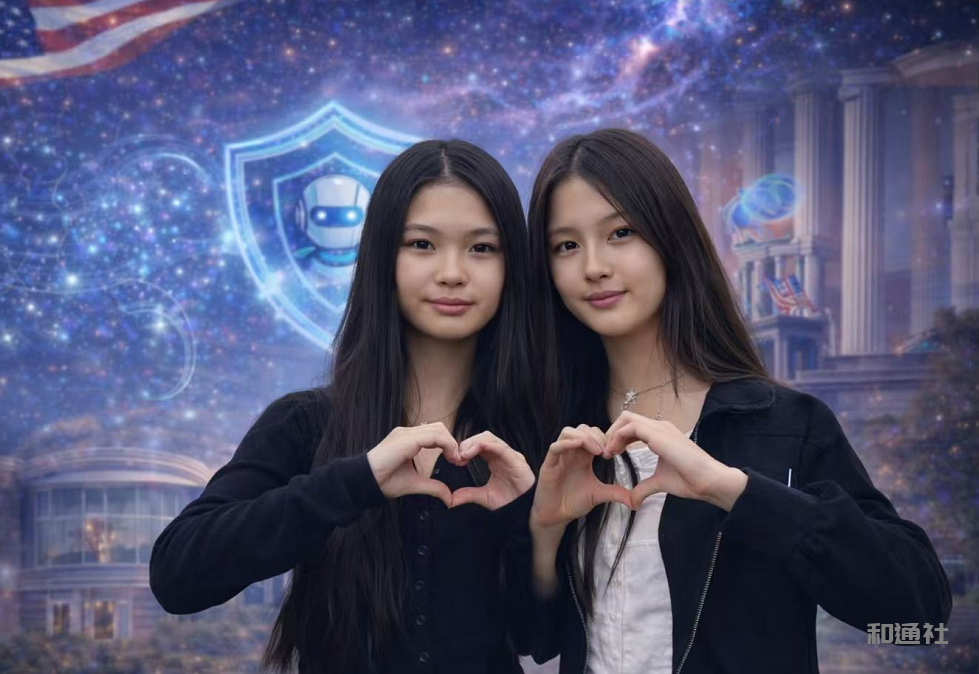
和通社讯 驻北美首席记者 钟将岩 王天剑 记者获悉,最近作为 AI 校园安全倡议的联合发起人与总统AI挑战参赛者,Eirene Hope Liu 与Lydia Lin 在白宫AI赛官方评选结果公布前,罕见获得总统的直接回信表彰。
2026年2月2日 纽约长岛杰里科讯(记者Harmony Liu) 白宫总统AI全国挑战赛评选结果尚未揭晓,一项由两位14岁华裔青少年主导的AI校园安全倡议已率先获得最高关注——美国总统于1月28日亲笔签署正式回信,公开肯定该倡议的价值与意义。据白宫事务观察人士表示,评选未结束前总统亲自回信认可青少年参赛者,实属罕见,这一回应也让这场由青少年发起的公共倡议,成为美国科技与公共安全领域的热议焦点。
此次引发白宫高度关注的AI校园安全倡议,由Eirene Hope Liu(刘昕媛)发起、Lydia Lin(林晓莉)联合推进,二人也是白宫AI总统挑战赛的参赛选手。该挑战赛由美国第一夫人倡导,而刘昕媛与林晓莉提交的方案,因理念完整、贴合校园安全现实需求且具备技术可行性,迅速进入白宫相关部门视野,最终在评选结果公布前,迎来了总统的亲笔回信。信中,总统不仅肯定了两位少女对国家公共安全议题的深入思考,更鼓励她们始终以责任感、品格与善意参与公共事务,这份国家级肯定,也让青少年的公共参与力量得到了官方认可。
这一倡议的诞生,源于二人对美国校园安全现状的长期关注。面对近年来频发的校园枪击事件与各类公共安全风险,刘昕媛和林晓莉开展了持续的校园安全数据收集与调研,在致总统、第一夫人、国会领导层及多家主流媒体的公开信中,她们抛出了直击行业痛点的问题:“当AI已广泛应用于金融、国防和医疗领域,作为AI最发达的美国,是否也应率先将AI引入校园安全体系,以更好地保护下一代?”这份公开倡议与她们提交的挑战赛方案形成呼应,构建出兼具公共价值、技术逻辑与政策现实意义的完整提案,也让青少年的理性思考,成为推动校园安全升级的重要声音。
作为倡议发起人,刘昕媛同时担任公共倡议与价值框架负责人,主导了倡议的整体理念设计、价值框架构建与公共表达,她始终强调AI技术的校园应用应围绕生命安全、心理健康、教育公平三大核心展开。其“科技的使命不是取代人类判断,而是帮助我们更早发现风险、守护生命”的观点,还曾被《福布斯》引用,她也被该媒体评价为“青少年一代中的Game Changer(变局者)”。
林晓莉则以共同倡议人的身份,承担起调研与方案协同推进的核心工作,在校园安全现状及相关数据调研、青少年心理健康议题系统整理、政策语言与技术表达的协调转译等方面发挥关键作用。她将青少年对校园安全的直觉性关切,转化为政策层面可理解、可评估的系统化方案,为倡议落地搭建起政策与技术之间的沟通桥梁。
为让AI校园安全倡议不止停留在理念层面,两位联合倡议人已开启落地筹备工作,计划寻找马斯克、黄仁勋等AI系统与技术研究科学家展开合作,同时招募合作伙伴推进设计与可行性研究。具体将围绕整合AI校园安全前沿技术路径、研究行为识别与异常模式预警及心理风险分析、构建“预警—干预—响应”系统性技术框架、选定具备落地条件的试验城市与学校四大方向推进,为倡议奠定扎实的技术基础。
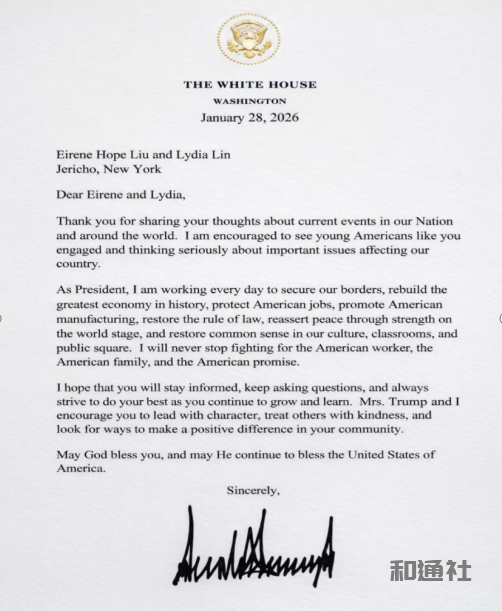
此次总统的亲笔回信,也被外界视作其“行动迅速、直接倾听”执政风格的又一次体现。信中,总统着重强调了公民责任、品格与善意及未来领导力的重要性,而从二人提交公开信和挑战赛材料,到收到总统亲笔回信,短时间内的高效回应,也让众多教育界人士与家长感慨,这是一位对现实问题高度敏感、愿意直面青年声音的总统。
目前,刘昕媛与林晓莉仍在等待白宫AI全国挑战赛的评选结果,但二人的行动并未就此止步。她们已制定清晰的未来规划:持续完善AI校园安全技术方案,推动地方层面的讨论与试点项目,与工程师、心理学家及教育专家开展跨领域合作,并以青少年代表身份,参与更高层级的科技伦理与公共安全对话,让青少年的声音在更广阔的平台被听见。
“在结果公布之前,总统已经用行动给予了我们肯定。这说明,只要方案真实、可行,年轻人的声音同样会被认真倾听。”刘昕媛说。林晓莉则表示:“我们不是在等待未来,我们正在参与当下。”
在AI技术、校园安全与社会信任高度交织的当下,两位华裔少女用理性的思考、主动的行动与勇于承担公共责任的态度,展现出美国社会下一代的珍贵力量。而这场由青少年发起的AI校园安全倡议,不仅为美国校园安全升级提供了新的思路,更让外界看到,年轻一代正以实际行动参与社会建设,成为推动时代进步的新生力量。
Eirene Hope Liu and Lydia Lin Participate in the White House Presidential AI Challenge, with Their Campus Safety Initiative Reaching the White House—Receiving Rare Direct Written Praise from the President Before the Official Announcement of Results!
As co-founders of the AI Campus Safety Initiative and participants in the Presidential AI Challenge, Eirene Hope Liu and Lydia Lin received rare direct written commendation from the President before the official results of the White House AI competition were announced.
Ahead of the announcement of the White House Presidential AI National Challenge results, an AI campus safety initiative led by two 14-year-old Chinese-American teenagers has already garnered the highest attention — the US President signed a personal official reply on January 28, publicly affirming the initiative’s value and significance. According to observers of White House affairs, it is extremely rare for the President to personally reply and recognize teenage participants before the conclusion of the competition, and this response has made the public initiative launched by teenagers a hot topic in the fields of American technology and public safety.
The AI campus safety initiative that has drawn the White House’s close attention was launched by Eirene Hope Liu and jointly advanced by Lydia Lin, both participants in the White House Presidential AI Challenge championed by the US First Lady. The proposal submitted by Liu and Lin quickly came to the attention of relevant White House departments for its complete philosophy, close alignment with the practical needs of campus safety and technical feasibility, ultimately earning a personal reply from the President before the competition results were announced. In the letter, the President not only affirmed the two teenagers’ in-depth reflection on national public safety issues but also encouraged them to always participate in public affairs with a sense of responsibility, integrity and goodwill. This national recognition has also given official validation to the power of youth participation in public affairs.
The initiative was born out of the two girls’ long-standing attention to the current state of campus safety in the United States. Confronted with the frequent occurrence of school shootings and various public safety risks in recent years, Liu Xinyuan and Lin Xiaoli have conducted continuous data collection and research on campus safety. In an open letter to the President, the First Lady, congressional leaders and major mainstream media outlets, they raised a pointed question hitting the industry’s pain points: “As AI is widely applied in finance, national defense and healthcare, should the United States, the most advanced country in AI, take the lead in introducing AI into the campus safety system to better protect the next generation?” This public initiative echoes the competition proposal they submitted, forming a complete plan with public value, technical logic and practical policy significance, and turning teenagers’ rational thinking into an important voice for advancing the upgrading of campus safety.
As the initiator of the initiative, Eirene Hope Liu also serves as the person in charge of public advocacy and value framework, leading the overall conceptual design, value framework construction and public communication of the initiative. She has always emphasized that the campus application of AI technology should center on three core pillars: life safety, mental health and educational equity. Her viewpoint that “the mission of technology is not to replace human judgment, but to help us detect risks earlier and protect lives” has also been quoted by Forbes, which named her a “Game Changer among the teenage generation”.
Lydia Lin, as a co-initiator, undertakes the core work of research and program coordination, playing a key role in the investigation of the current situation of campus safety and relevant data, the systematic sorting of adolescent mental health issues, and the coordinated translation between policy language and technical expression. She has transformed teenagers’ intuitive concerns about campus safety into a systematic plan that is understandable and evaluable at the policy level, building a communication bridge between policy and technology for the implementation of the initiative.
To ensure that the AI campus safety initiative is not just a conceptual effort, the two co-initiators have launched preparation work for its implementation, planning to collaborate with AI system and technology research scientists such as Elon Musk and Jensen Huang, and simultaneously recruiting partners to advance design and feasibility studies. Specifically, they will focus on four key directions: integrating cutting-edge technical pathways for AI campus safety, researching behavior recognition, abnormal pattern early warning and psychological risk analysis, constructing a systematic technical framework of “early warning – intervention – response”, and selecting pilot cities and schools with the conditions for implementation, laying a solid technical foundation for the initiative.
The President’s personal reply has also been regarded by the outside world as another embodiment of his governing style of “acting quickly and listening directly”. In the letter, the President highlighted the importance of civic responsibility, integrity and goodwill, and future leadership. The efficient response in the short period from the two girls submitting the open letter and competition materials to receiving the President’s personal reply has also moved many educators and parents, who commented that this reflects a President who is highly sensitive to practical issues and willing to face the voices of young people directly.
At present, Eirene Hope Liu and Lydia Lin are still awaiting the results of the White House Presidential AI National Challenge, but their actions have not stopped there. They have formulated a clear future plan: to continuously improve the AI campus safety technical proposal, promote local-level discussions and pilot projects, carry out cross-disciplinary cooperation with engineers, psychologists and education experts, and participate in higher-level dialogues on technological ethics and public safety as youth representatives, so that the voices of teenagers can be heard on a broader platform.
“Before the results were announced, the President has already given us recognition through his actions. This shows that as long as the proposal is genuine and feasible, young people’s voices will also be taken seriously,” said Eirene Hope Liu. Lydia Lin added: “We are not waiting for the future; we are participating in the present.”
At a time when AI technology, campus safety and social trust are highly intertwined, the two Chinese-American teenagers have demonstrated the precious strength of the next generation of American society through their rational thinking, proactive actions and courage to take on public responsibility. The AI campus safety initiative launched by teenagers not only provides new ideas for the upgrading of campus safety in the United States but also lets the outside world see that the younger generation is participating in social construction with practical actions and becoming a new driving force for advancing the times.










评论区
暂无评论,快来抢沙发~